


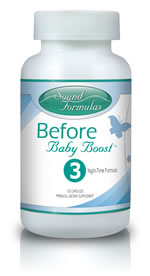
Before Baby Boost 3 - 120 CP
Before Baby Boost™ Nighttime Formula* is an all-natural way to enhance mother's sleep during pregnancy while helping baby's body to develop strong healthy bones. This nighttime formula provides highly absorbable forms of calcium and magnesium in the ideal ratio for pregnancy. This special mineral formula helps to prevent mother's bones from becoming overly depleted in these very important minerals. Take good care of yourself while preparing your baby for a healthy life.
For best results take the complete Before Baby Boost™ prenatal 3 bottle program throughout your pregnancy.
| Supplement Fact | ||
|---|---|---|
| Servings per container: 30 | ||
| Serving size: 4 capsules | ||
| Amount Per Serving | % Prenatal Daily Value | |
| Calcium (from Calcium Citrate) | 600mg | 46% |
| Magnesium (from Magnesium Citrate) | 200mg | 44% |
| Other Ingredients: Gelaint Capsule, Magnesium Stearate |
About Calcium and Magnesium
Calcium for Moms
As a nursing mom you need about 1200 milligrams of calcium per day. Calcium is a mineral that the body uses for many things: during pregnancy it helps the baby's bones and teeth develop; it helps make breast milk and it also helps to regulate blood pressure, heartbeat, water balance in the cells and muscle contractions. During pregnancy and lactation your body uses calcium that is stored in your bones to supply your baby and breast milk. So not only does baby need calcium, but you do too and if baby is taking stored calcium from your body during the nursing process, it makes sense to both take a supplement and eat calcium rich foods. The bonuses for getting the right amount of calcium will mean strong bones for you, and there have been studies, which show that postpartum women getting sufficient calcium, more easily reclaim their pre-pregnancy weight.
The Recommended Daily Allowance
The Daily allowance for women is 1200 milligrams during pregnancy and lactation. Most prenatal vitamins do not contain much calcium, so you may need to ask your doctor for a good calcium supplement. Many doctors now tell new mothers to continue taking their prenatal vitamin for several months after pregnancy. So while nutritional support after pregnancy is a good idea, your prenatal, in most instances, will not supply you with sufficient calcium. Do not expect your prenatal vitamin to support your post pregnancy needs.
To take 1200 units of calcium as a supplement, you would need to take it four times a day for the body to process and metabolize it. This creates a dilemma if you are taking a multiple vitamin that contains iron, as iron and calcium are best absorbed into the body separately.
We at Sound Formulas Recommend
That you get some of your calcium from vitamin supplementation and some from food sources. Take calcium at night away from your other nutrients and eat a diet in calcium rich foods.
Increasing Calcium Intake
| Each food listed below is based upon milligrams per 100 grams of an edible portion = or a 3 ounce serving size. | |||
|---|---|---|---|
| Kelp | 1093 | Water Cress | 151 |
| Swiss Cheese | 925 | Goat Milk | 129 |
| Cheddar Cheese | 750 | Dried Figs | 126 |
| Dulse | 296 | Sunflower Seeds | 120 |
| Collard Greens | 250 | Whole Milk | 118 |
| Turnip Greens | 246 | Buttermilk | 121 |
| Barbados Molasses | 245 | Cottage Cheese | 94 |
| Almonds | 234 | Spinach | 93 |
| Brewers Yeast | 210 | Cooked lentils | 25 |
| Corn Tortilla | 200 | ||
| Cooked Salmon | 140 | ||
| Cooked Soybeans | 150 |
Nut butters such as almond, hazelnut and sunflower have around 60 to 70 milligrams of calcium.
Add acid when cooking dried beans or leafy greens. This aids in calcium availability and decreases gas formation. Add one tsp. of vinegar or one tsp. of lemon or lime juice to cooked greens or beans.
Recent research shows that the nutrient magnesium may play an important role in health. It may aid in regulating blood pressure, and may be of benefit for premenstrual disturbances and fatigue. And magnesium deficiencies may be far more common in the United States than doctors realize. The recommended daily intake of magnesium is around 300 milligrams per day. Add to that another 100 milligrams if you are pregnant or nursing.
Magnesium plays a role in the synthesis of proteins and this makes the mineral important for the health of tissues in the body. Like calcium, magnesium (about 60% of it) is found in the bones. The remaining 40% is found in muscle and soft tissue. In teeth, magnesium interacts with calcium to maintain tooth enamel. It may interact with calcium in other ways too as most calcium rich foods also supply a good source of magnesium. Like calcium, magnesium is a mineral that helps to promote relaxation.
At Sound Formulas, we have combined calcium and magnesium together in a nighttime formula that will promote restful sleep while providing you with nutrients your body needs. You need to be sure to eat calcium rich foods such as the ones listed and take one serving of AfterBaby Boost™ daily.*


